

 News
News 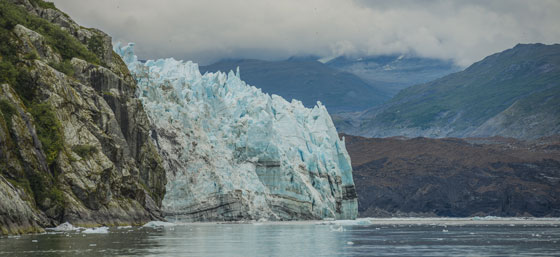
Since 2008, Jaeger-LeCoultre and Unesco have been working together to protect the 47 marine sites appearing on the World Heritage list. The support that Jaeger-LeCoultre lends to the preservation of these unique marine treasures is part of an approach dedicated to sustaining the most precious resources on our planet.
To reassert its long-term commitment, the manufacture has made a short video on Glacier Bay National Park (USA), recognising the work of scientists and project managers that preserve the site.
Every year, Jaeger-LeCoultre pays tribute to a marine site appearing on the Unesco World Heritage list. This year, the spotlight is being turned on Glacier Bay National Park and Reserve, located on the Canadian border of Alaska.
As Scott Gende, Senior Scientific Advisor of Glacier Bay, explains: «The scientific research conducted there is of the uttermost importance. The zone was declared an American national monument in 1925 due to the unique possibility it affords of studying the succession of glacial periods. That is why the project leaders at Glacier Bay encourage both general research such as glaciology and the evolution of the landscape, as well as more applied studies focused on the consequences of incursions.»
A true inspiration for all marine advocates of the oceans, this park was an obvious choice for Jaeger-LeCoultre. The video retraces the history of the site, which was inscribed on the Unesco World Heritage list in 1992. Not only does it shelter some of the last glaciers on our planet, but also large areas of nonpolar icefields, a spectacular forest and numerous fjords. It is home to mammals such as porpoises, seals, sea lions, several species of whales as well as the famous sea otter whose precious fur almost caused its extinction several centuries ago.
These marine animals live in perfect harmony at Glacier Bay thanks to a set of very strict preservation policies and management rules. The effective administration of the park has allowed species at risk such as the humpback whale and the sea lion to find a sure refuge.
Long before its inscription on the World Heritage list, Glacier Bay was already a privileged site for scientific research. While humpback whales come to feed in this zone during their migration, collisions with cruise boats have occurred, causing near fatal and sometimes deadly injuries. In 2005, a research program was launched in order to solve this problem.
Since then, all boats entering the park have been inspected by the onsite teams. This project is the first one of this amplitude to constantly gather data on the interaction between boats and the large marine mammals. As they begin exploring the park, the boats have marine mammal biologists on board who are able to detect every whale in the zone using special binoculars. As soon as a whale is spotted, an automatic message is sent to the captain, allowing him to adjust his route and speed. The results of this endeavour have served to establish a new set of navigation rules in the Glacier Bay area that have considerably reduced the risks for the humpback whales, making this unique place a true refuge for them.
June 04, 2015