 News
News Routine inspections can sometimes lead to large-scale seizures of contraband. An example in Italy.
On the morning of 18 August, the sun rose tranquilly over the port zone of Bari (region of Pouilles, southern Italy). As was the case every morning, the ferries at their moorings began to empty their cargo of trucks onto the busy quayside. From its home port in Greece, one such vessel had sailed through the night. The crossing had been trouble-free, the sea was calm and drivers had accumulated their rest hours. All were impatient to get on the road and complete their journeys across Europe without wasting another minute.
Suddenly, the serene calm of the sea was broken by the excited hubbub of terra firma, caused moreover by something spotted by every driver leaving the ferry. It was a device which, they knew, could spoil the day of one of their number: the customs scanner. Its presence raised excitement levels a notch or two. Even for those with nothing to hide, the gantry represents a loss of time and an annoying formality that every truck driver would willingly avoid. An initial truck was selected. Customs officers signed to the driver to exit the column so that his trailer could pass under the gantry at a walking pace.
In the gantry cabin, the operator had his eyes riveted to the screen. Contrary to belief, the equipment does not allow the cargo to be viewed. The scanner’s rays highlight only subtle differences in density. The operator compares these nuances with goods listed in the driver’s customs documents to detect possible inconsistencies. Schematically, a low density could indicate organic matter, for example cigarettes (or clandestine immigrants), whereas at the other end of the scale a very high density would indicate metals, and therefore perhaps watches.
Despite the early hour, there was no escaping what the screen showed the operator. In the middle of a cargo supposedly consisting of textiles, he could clearly make out a large, high-density cube, the equivalent of three pallets of objects with a clearly metallic composition. A sign to his colleague was enough. A physical inspection was required. For the driver, the tachometer stopped there and then. His trailer would not be passing through the barriers of the commercial port. Not that day, at least.
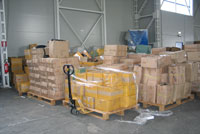
This ordinary day (or disastrous depending on your point of view) was already well advanced when the official statement was issued. "Today, 18 August, customs authorities in Bari seized slightly more than 80,000 fake watches. Concealed in a truck originating from Greece and intended for the Spanish market, the counterfeit goods were discovered during a routine inspection. The fraudulent goods will be destroyed once an inventory has been taken. The driver meanwhile was taken into custody by the Guardia di Finanza for questioning."
October 12, 2010