
Deep dive into water resistance
Static pressure
Static pressure relates to the weight of the water column above the watch and depends solely on the depth of immersion. It is uniformly applied across the watch’s entire outer surface.
It is calculated as follows:
Pstatic = ρ · g · h
Where:
- ρ: fluid’s density
- g: acceleration due to gravity
- h: height/depth
Dynamic pressure
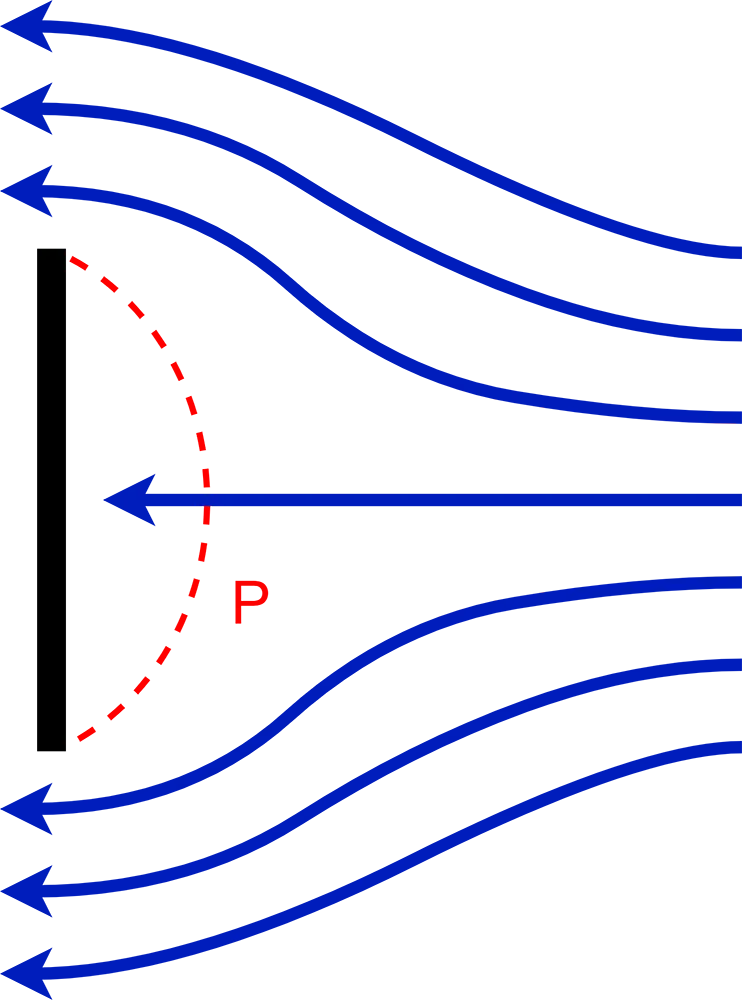
Dynamic pressure, on the other hand, depends on the relative movement between the watch and the water. The watch may be stationary while the water is moving, or vice versa. This pressure is not uniform, instead relating to the geometry of the watch. In laminar flow, it reaches its maximum at the “stagnation point” corresponding to the point where the liquid flow splits in two to flow around the object.
It is calculated as follows:
Pdynamic = ½ · ρ · v2
Where:
- ρ: density of water
- v: relative velocity between the water and the watch
Total pressure
The total pressure exerted on a watch in contact with water is the sum of the two pressures – static and dynamic – as the physical phenomenon is the same. They will however be exerted with varying intensity depending on the type of activity: static pressure will dominate during scuba diving (at depth, at low speed); dynamic pressure during a dive off a diving board (mostly at the surface, but at high speed).
A watch water-resistant to 2 bar (approximately 20 m depth) is in fact sufficiently robust for all common water sports and domestic situations involving water. To reach a dynamic pressure of 2 bar, one would indeed need to jump from a height of 20 metres (approx. 70 km/h), a practice that falls outside the scope of ordinary activities.
The phenomenon of condensation
A water-resistant watch is designed to prevent water and dust from entering, but it is not gas-tight – particularly with regards to water vapour. This physical phenomenon known as permeation enables moisture from the external environment to gradually enter the watch. Permeation occurs when there is a difference in gas concentration between the inside and outside of the watch. In such cases, materials’ ability to capture water-vapour molecules (moisture), diffuse them through the material and then release them on the other side will balance out the humidity between the inside and outside, over a variable period of time.
The humidity level inside a watch worn in a humid climate will therefore be higher than it would be in a dry climate. This natural humidity does not affect the watch’s functionality.
During a thermal shock, such as a rapid change from hot to cold (for example, when entering an air-conditioned room or when swimming in cold water), condensation may occur: water in its gaseous state turns into a liquid, in the shape of fine droplets that form under the watch glass. This temporary condensation or “misting” will disappear within a few minutes and does not indicate a water resistance fault in the watch.
Technology and materials
The technical component enabling a watch to be water-resistant is the gasket (seal). This element is positioned between two parts of the watch case wherever there is a risk of water ingress: between the caseback and the case middle; the crystal and the bezel; as well as around the crown and any pushers.
The mechanism’s effectiveness depends on the quality of the materials and the perfect integrity of the components, particularly polymer gaskets, as these can lose their properties over time and compromise the watch’s water resistance.
For this reason, it is advisable to follow the manufacturer’s recommendations and service advice to maintain water resistance.
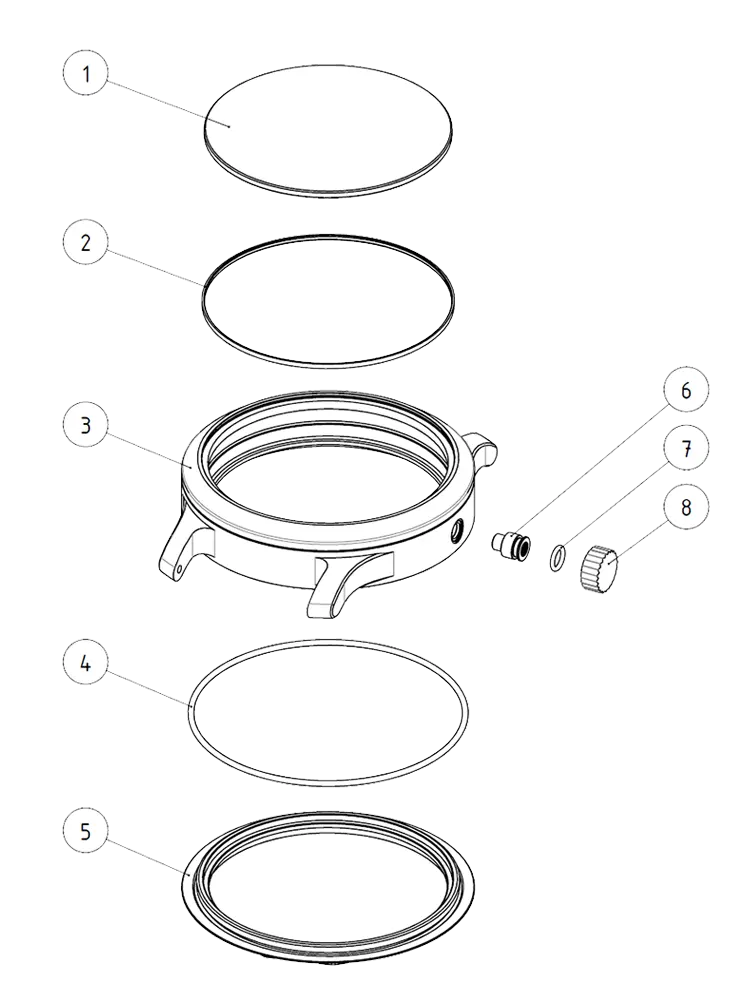
- Crystal
- Crystal gasket
- Case middle
- Caseback gasket
- Caseback
- Crown tube
- Crown gasket
- Bezel
Markings and references to standards
A water-resistant watch may be marked “water-resistant” or one of the authorised translations and shall comply with the requirements of ISO 22810. Other markings – often used incorrectly – such as “waterproof” or “water-resist”, do not correspond to any official standard. The marking may be supplemented by an indication of the pressure limit in bar, or the equivalent immersion depth in metres.
Meanwhile, divers’ watches are covered by the ISO 6425 standard. A watch claiming compliance with this standard may bear the marking “diver’s watch L m”, where L indicates the depth in metres guaranteed by the manufacturer. The accompanying documentation shall explicitly refer to the ISO 6425 standard.